Workstream
Climate Solutions
Most midsize businesses are being asked for Scope 3 numbers by customers, lenders and regulators before they have the data or the team to produce them. We build the baseline from what you already have, then put carbon KPIs where buying decisions actually get made.
Working prototype
Supplier Baseline Generator: demo
A working prototype that turns supplier spend into a Scope 1, 2 and 3 baseline, then helps buyers choose lower-carbon suppliers.
Climate
Measured by: Supplier emissions coverage and data-quality score
Book a live demo on your dataRead the transcript
This short demo walks through the Supplier Baseline Generator on sample data.
It starts with a year of supplier spend turned into a Scope 1, 2 and 3 baseline, with emissions broken down by category and by supplier.
It then moves into the procurement view, where a category manager compares two suppliers on cost, lead time, carbon intensity and compliance, and gets a clear recommendation with the trade-offs shown.
Finally, it models the cost of doing nothing against acting now, alongside regulatory and market risks such as CBAM and the UK ETS. The company shown is an example, and all figures are illustrative.
The chores
What’s holding teams back
- Customers and lenders want supplier emissions data you do not have yet.
- Spreadsheets of spend and invoices sit unused because nobody has time to map them.
- Sustainability reporting lives apart from procurement, so it never changes a decision.
What we build
Tools your team will actually use
Supplier Baseline Generator
Turns spend, invoices and public filings into a supplier-level Scope 3 baseline, with a confidence rating on every line.
Carbon KPIs in the workflow
Supplier carbon intensity shows up in sourcing and review workflows, next to price and lead time.
Supplier engagement packs
Prioritised supplier lists and data requests, so you chase the few suppliers that move the number.
What you get
An audit-ready baseline report, not just a dashboard
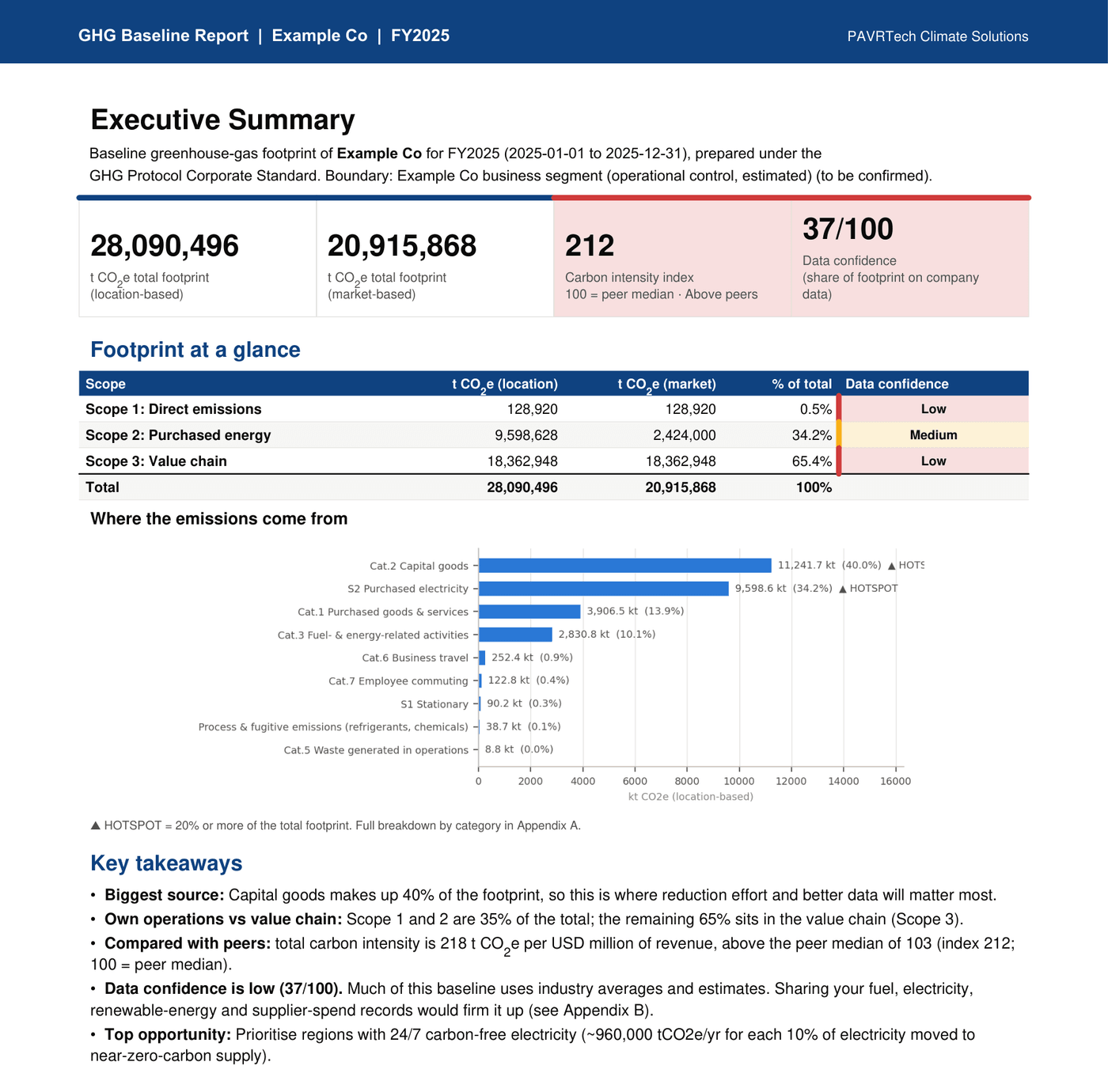
Every baseline comes with a report your board, customers and auditors can read: totals by scope, a confidence rating on every line, the biggest sources ranked, a comparison with peers and the next actions. It follows the GHG Protocol Corporate Standard, and every figure traces back to a documented source.
The PAVR Method
From chore to running system in about eight weeks.
Pinpoint, Automate, Validate, Run. Each phase has a clear output, so you only commit to the next step once the last one has proved its value.
Pinpoint
Weeks 1 to 2
Map your top suppliers, spend data and the gaps in your Scope 3 picture.
Automate
Weeks 2 to 6
The Supplier Baseline Generator fills the gaps from invoices, spend and public filings.
Validate
Weeks 6 to 8
Check estimates against supplier disclosures and what your auditors expect.
Run
Ongoing
Carbon KPIs live in procurement workflows and refresh every month.
A defensible supplier baseline in weeks, and carbon data that shapes buying decisions.
The first step · 2 weeks
Start with a two-week Pinpoint Sprint.
A fixed-fee, two-week sprint that finds the chore worth automating and proves whether AI can take it off your plate. If you go ahead with the build, the fee is credited in full.
- Fixed fee, agreed up front
- Credited in full against the build
- Yours to keep, even if you stop there
You leave with
- A map of the process and where the time and money go
- A data audit: what you have, what is missing, what it would take
- The one KPI we will be measured against, with today’s baseline
- A business case with expected payback, and a clear go or no-go
Experts on this workstream
Who you’ll work with
- Former Head of Supply Chain, major UK retailer
Former Head of Supply Chain, major UK retailer
- ESG and carbon accounting specialist
ESG and carbon accounting specialist
Frequently asked questions
Do we need clean data before we start?
No. Most clients start with spend exports and invoices. The Pinpoint phase maps what you have, and the baseline shows a confidence rating so you know where better data would help.
Why does Scope 3 matter so much for a midsize supplier?
Because for most businesses the supply chain is where the emissions are, and large customers now ask their suppliers for the numbers.
- Supply chain (Scope 3) emissions are on average 26 times higher than a company’s own operational emissions.
- Only 15% of companies disclosing to CDP have set a Scope 3 target, so early movers stand out to customers and lenders.
- A spend-based baseline with confidence ratings gets you a defensible first number in weeks, then improves as supplier data arrives.
Source: CDP and BCG, Scope 3 Upstream: Big Challenges, Simple Remedies (2024)
Which standards does the baseline follow?
The baseline follows the GHG Protocol Scope 3 categories, so it can feed into the reporting frameworks your customers and lenders ask for.
Does this replace our sustainability consultant?
It usually makes them more effective. We build the data pipeline and workflow tools; your advisers can spend their time on strategy instead of spreadsheets.
Free download
Is your chore ready for AI? Find out in ten minutes.
Our AI Readiness Checklist: ten plain-English questions, a simple score and what to fix first.
Get started
Tell us the chore that’s holding you back.
A 20-minute call with a founder and, where it helps, one of our industry experts. No slides, no obligation. You leave with a view on whether AI can take the chore off your plate.
Or tell us about the chore and we’ll come back to you.
Book a 20-minute call
Calendar not loading? Open it in a new tab.